
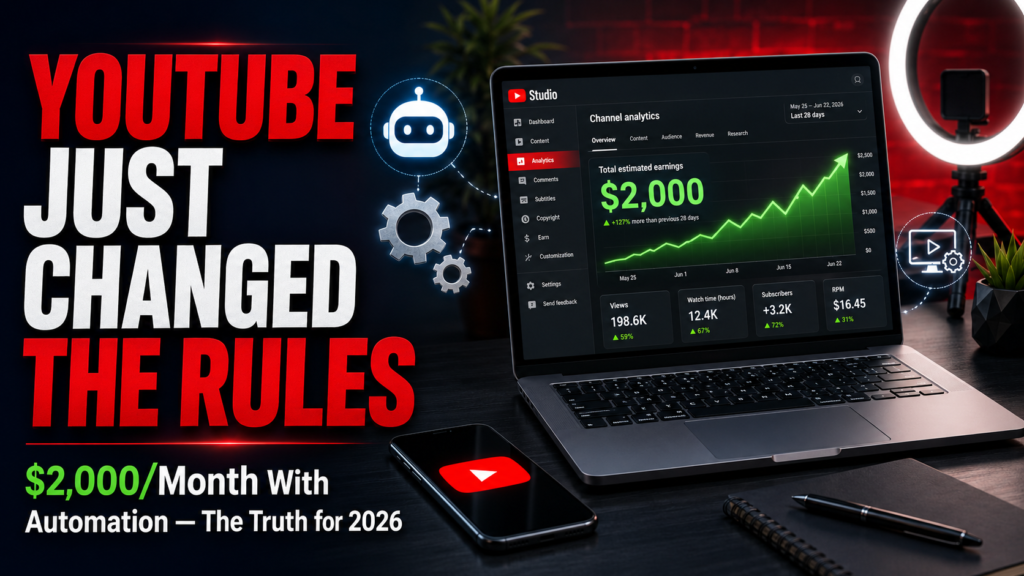

YouTube automation is the practice of building and running a channel without ever appearing on camera yourself. Instead of filming your own face, you handle (or outsource) the scripting, voiceover, and editing, while you focus on strategy, niche selection, and growth. It’s often called a “faceless channel,” and it’s been one of the most talked-about online business models of the past few years.
It can still be profitable in 2026 — but the rules have tightened, and the lazy, fully-automated version of this business is dying fast. Here’s what actually works now.
What a YouTube Automation Channel Looks Like
A typical automation channel runs on four components:
- Niche and research — choosing a topic with consistent search demand and ad value (finance, true crime, history, tech reviews, motivation, luxury lifestyle, etc.)
- Scripting — written either by you, a hired writer, or AI tools, then edited for accuracy and originality
- Voiceover — a human narrator or a high-quality AI voice
- Visuals and editing — stock footage, licensed clips, AI-generated imagery, or screen recordings, cut together with pacing and captions
You can do all four steps yourself, hire freelancers for each stage, or build a small remote team once the channel earns enough to reinvest.
The Big Shift: Why “Fully Automated” No Longer Works
In 2025 and 2026, YouTube significantly tightened enforcement around what it now calls “inauthentic content” (previously labeled “repetitious content”). The platform isn’t banning AI or automation — it’s targeting channels where AI does everything and a human adds nothing.
Channels that have been hit hardest typically share these traits:
- AI text-to-speech reading scraped articles over generic stock footage, with zero commentary or analysis
- Near-identical videos published on a rigid template, multiple times a day
- Compilation or “facts” channels reusing clips with no meaningful transformation
- AI-generated news readers with no original voice or perspective
Channels that are still earning well tend to add a layer of real human judgment: original scripts with actual research, distinct commentary or a consistent narrative voice, custom edited visuals, and a format that varies instead of repeating the same five-minute template forever.
The practical takeaway: automation should speed up production, not replace creative effort entirely. If you (or your team) aren’t adding research, opinion, structure, or a creative angle, the channel is at real risk of losing monetization.
Step-by-Step: How to Start
1. Pick a niche with both demand and “addable value”
Avoid niches that are purely descriptive (“here’s a list of facts”) with nothing to add. Favor niches where commentary, analysis, or storytelling naturally fits: finance breakdowns, history deep-dives, true crime analysis, tech comparisons, or “explained” content with a real point of view.
2. Build a real script, not a scraped one
Use AI tools (ChatGPT, Claude, etc.) to draft and speed up scripting, but make sure a human reviews, fact-checks, and injects original framing or opinion. A script that’s 90% AI output with zero human edit is exactly the pattern YouTube’s systems are trained to flag.
3. Choose your voice
Two paths:
- Hire a human voiceover artist (sites like Fiverr or Voices.com) — generally the safer, more “authentic-sounding” route.
- Use an AI voice generator (e.g., ElevenLabs and similar tools) — acceptable on YouTube, but pair it with strong scripting and editing so the video doesn’t feel mass-produced.
4. Source or create visuals
Stock footage libraries (Envato Elements, Storyblocks, Pexels) are the standard low-cost option. For more original content, consider screen recordings, AI image generation, or licensed B-roll. Avoid leaning entirely on the same generic AI-image style across every video — visual repetition is one of the patterns YouTube’s review systems watch for.
5. Edit with intention
Pacing, captions, sound design, and thumbnail design matter as much as the script. This is the stage where many automation channels cut corners — and it shows. A well-edited video with mediocre AI narration will usually outperform a poorly-edited one with a perfect script.
6. Publish consistently, not constantly
Quality and consistency beat sheer volume. Multiple uploads per day on a rigid template is exactly what gets flagged as low-value. A steady, sustainable schedule (1–3 well-made videos a week, for most niches) is safer and usually performs better long-term.
7. Meet monetization requirements
The core YouTube Partner Program thresholds remain 1,000 subscribers plus either 4,000 watch hours in the past 12 months or 10 million Shorts views in 90 days. Hitting those numbers gets you into the program — staying monetized afterward depends on continuing to avoid the “inauthentic content” classification.
Realistic Costs to Expect
| Item | Typical Monthly Cost |
|---|---|
| AI voice generator | $20–30 |
| Stock footage subscription | $15–30 |
| Scriptwriter (freelance) | $50–300 per video, or flat monthly retainer |
| Video editor (freelance) | $50–250 per video |
| Thumbnail design | $10–40 per thumbnail |
Many people start by doing the scripting and editing themselves to keep costs near zero, then reinvest ad revenue into outsourcing once the channel proves itself.
Realistic Earnings
Earnings vary enormously by niche, audience country, and ad demand. Finance, business, and tech niches tend to have far higher ad rates (RPM) than entertainment or general “facts” channels, sometimes by a factor of 10 or more. Shorts-focused channels typically earn dramatically less per view than long-form content.
Because ad revenue alone can be unpredictable — CPMs shift with the season and with each policy update — most successful automation creators diversify into:
- Affiliate marketing within video descriptions
- Sponsorships once the channel has an audience
- Selling a digital product, course, or service related to the niche
- Repurposing long-form videos into Shorts/Reels/TikTok clips for additional ad and bonus-program revenue
The Honest Risks
- Policy risk: enforcement has tightened and can change again with little warning. Channels built entirely on low-effort automation are the most exposed.
- Income volatility: ad rates swing with advertiser demand and the time of year.
- Saturation: easy, templated niches (random “facts,” reaction compilations, AI news readers) are heavily oversaturated and increasingly scrutinized.
- Copyright exposure: unlicensed clips, unauthorized AI voice clones of real people, or AI-generated music too similar to existing songs can trigger strikes.
Bottom Line
YouTube automation is still a legitimate business model in 2026, but the version that wins now looks less like “set it and forget it” and more like “build a lean media production process.” The creators who succeed treat AI and outsourcing as tools that remove the busywork of content creation — scripting drafts, voice generation, basic editing — while they keep tight control over research, original commentary, and creative direction.
If you’re willing to add real value at every stage instead of fully outsourcing the thinking, this is still one of the more accessible ways to build a content business without ever stepping in front of a camera.